Inflatable Power Planning
Bounce House & Inflatable Generator Guide
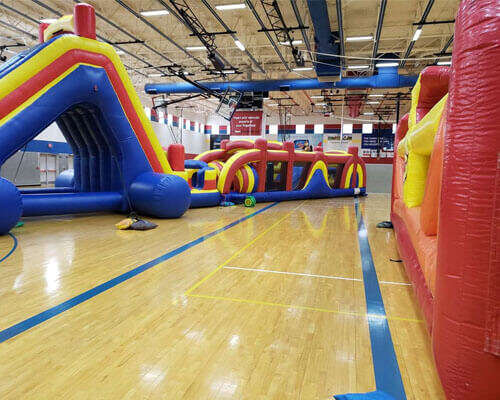
Planning power for an inflatable isn't as simple as counting bounce houses. Some inflatables use one blower, while larger obstacle courses, water slides, combos and other attractions may require multiple motors running continuously.
At Fun Times Party Rental, we plan power around the number of motors, the electrical requirements of the equipment, available power at the event site and operating redundancy — not simply the number of inflatables being rented.
The Most Important Rule
Count the Motors, Not the Inflatables
One of the easiest mistakes to make when planning inflatable power is assuming that one inflatable always equals one blower. It doesn't.
Within our inventory, some attractions use one motor, most of our obstacle courses use two, our 400-series combos use two, larger dry slides use two, and some larger water slides require two or three motors. One of our largest obstacle-course configurations requires four motors.
That means two inflatable rentals could require two motors — or considerably more. The type of attraction matters, which is why it helps to understand the differences between inflatable types before planning a larger setup.
The better question: How many motors need power, and what are their actual electrical requirements?
Real Event Power
Power Planning Becomes More Important as the Event Grows
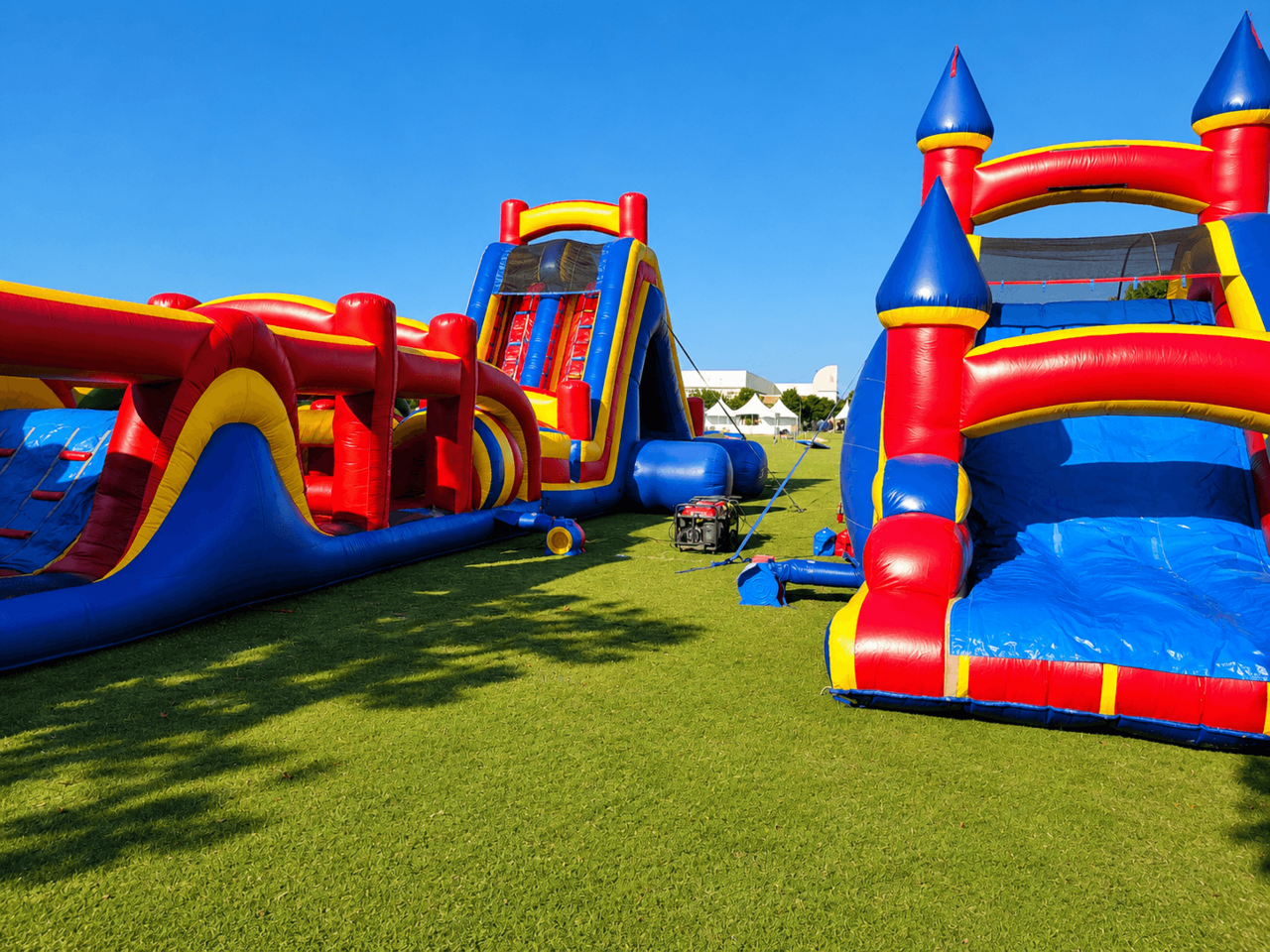
A single inflatable and a multi-attraction community event create very different electrical-planning problems. As the number and size of attractions grow, motor count, available circuits, generator load, fuel, placement and redundancy all matter more.
Why Do Inflatables Need Continuous Power?
Commercial inflatables use blowers that run continuously while the attraction is operating. The blower keeps air moving into the inflatable so it maintains the pressure and structure needed for use.
If power to the blower stops, the inflatable begins losing air. Dependable electrical power therefore needs to remain available throughout the rental period — not just during setup.
Running Power
Running power is the electricity the motor requires while operating normally and keeping the inflatable pressurized.
Starting Power
Electric motors can require additional power when they first start or restart. That's one reason we don't design a generator plan around using every available watt of capacity.
How We Plan Power
Our Generator Service Levels
Our generator planning is intentionally more conservative than simply asking how many motors a generator could theoretically operate at one time.
| Planned Motor Load | Generator Service / Load Level | How We Approach It |
|---|---|---|
| Up to 2 motors | 5,000-watt service level | Used for our planned two-motor load. |
| Up to 3 motors | 8,000-watt service level | Used when the planned load increases to three motors. |
| 4+ motors | Distributed power planning | We generally distribute the load instead of planning around pushing one generator to its maximum. |
Why We Don't Max Out Our Generators
We own several generators around the 9,000-watt class. Some can technically support four inflatable motors under the right conditions. That doesn't mean we want to build an event around operating them at their theoretical maximum.
Operating Headroom
Leaving capacity available gives us a more conservative operating plan rather than designing around the generator's absolute limit.
Equipment Longevity
Rental generators run repeatedly and often for hours at a time. We prefer not to continuously push small engines as hard as possible.
Unexpected Problems
Even properly maintained small-engine equipment can develop an unexpected issue during an event.
Redundancy
Multiple power sources can prevent one generator problem from affecting every attraction at the event.
Large-Event Reliability
Why Two Generators Can Be Better Than One
Imagine an event requiring four inflatable motors. Even if one generator could technically operate all four, putting the entire event on that one machine creates a single point of failure.
One Generator / Four Motors
If the generator stops, all four motors lose power and every attraction connected to it is affected.
Distributed Generator Load
Splitting the motors across power sources means one generator problem doesn't necessarily shut down the entire event.
For larger school events, church functions, corporate events, festivals and community celebrations, reliability can matter more than squeezing every available watt from one generator.
A 9,000-Watt Generator Doesn't Mean You're Using 9,000 Watts
The physical generator delivered to an event and the generator service/load level planned for the event aren't necessarily the same thing.
We may deploy one of our larger generators even when an event only requires the power level we use for two or three motors.
The equipment connected to the generator determines the operating load, and operating load also affects fuel usage. Seeing a larger generator at an event therefore doesn't mean the setup requires — or is using — the generator's maximum possible output.
How Many Motors Do Different Inflatables Use?
These examples from our inventory show why counting inflatables alone can give you the wrong answer.
| Attraction Type | Typical Motor Requirement |
|---|---|
| Many standard inflatables | 1 motor |
| Most of our obstacle courses | 2 motors |
| Our 400-series combos | 2 motors |
| Larger dry slides | 2 motors |
| Larger water slides | 2–3 motors |
| Largest obstacle configuration | 4 motors |
Multi-motor attractions are common in larger setups. You can compare our obstacle course rentals to see examples of attractions designed for larger groups and events.
Do I Need a Generator for a Bounce House?
Not necessarily. If appropriate electrical power is available at the event site and the circuit can support the equipment connected to it, generator power may not be necessary.
But an available outlet doesn't automatically mean adequate power is available. What matters is the electrical circuit supplying the outlet and what else is already connected to that circuit.
Two Outlets Don't Necessarily Mean Two Circuits
Multiple outlets can be connected to the same breaker. If several inflatable blowers or other pieces of event equipment are placed on the same circuit, the combined load can trip the breaker even though the equipment was plugged into different outlets.
This is one of several site details that should be confirmed before delivery. Our guide to common bounce house rental mistakes covers other planning issues that can affect setup day.
Parks & Municipal Facilities
Some Parks and Cities Require Generator Power
A park having electrical outlets doesn't necessarily mean rental companies are allowed to use them.
Some parks and municipal facilities require event organizers or rental companies to provide generator power because suitable electricity isn't available near the setup area. Others may require generators even when electrical service exists. Policies vary by facility.
One practical reason is load management. Delivery crews working with an unfamiliar facility may not know which outlets share breakers or how loads are distributed across the property. If multiple inflatable motors aren't balanced properly, breakers can trip, interrupt the event and create service calls for facility staff who then have to locate and reset the affected breaker.
Before renting at a park: ask the facility whether inflatable vendors may use facility electricity or whether generator power is required.
When Is a Generator a Good Idea?
- No suitable electrical service is available near the setup area.
- The venue doesn't have enough appropriate circuits for the equipment.
- A park or municipal facility requires vendors to provide generator power.
- The available building circuits or breaker layout are unknown.
- The event is in a field, parking lot or other area away from building power.
- Multiple inflatables make a controlled power plan preferable.
- A larger event benefits from distributing loads across multiple power sources.
- Other vendors or event equipment are already using facility electricity.
Don't Forget Everything Else Using Electricity
Inflatables aren't always the only equipment drawing power at an event. Concession machines, sound equipment, DJs, lighting, fans, photo booths, food-service equipment and other vendors may also be using the venue's electrical system.
An outlet that appears available for an inflatable could share a circuit with equipment inside the building or with another vendor's setup.
For complicated events, power should be planned just like space, staffing, access and guest flow.
Why Generator Fuel Usage Changes With the Load
The wattage printed on a generator doesn't mean the machine consumes fuel at one fixed rate regardless of what is connected to it. Operating load and conditions affect fuel consumption.
That's one reason our generator service levels can differ even when the same larger physical generator is deployed. A generator supporting two motors isn't operating under the same load as that generator supporting three motors for the same amount of time.
What Happens if Generator Power Is Lost?
If an inflatable blower loses power, the attraction begins losing pressure. Participants should exit the inflatable and follow the instructions provided for the rental or event.
This is another reason redundancy can matter at larger events. Distributing equipment across multiple power sources can reduce the number of attractions affected by a single equipment problem.
If you're using one of our generators, review our generator operating instructions before use.
From Backyard Parties to Festivals
Generator Planning for Larger Events
A single bounce house at a backyard or birthday party and a school, church, corporate or community event with multiple obstacle courses, games, slides and activity stations create very different power-planning needs.
As the event becomes larger, motor count, available circuits, equipment placement, generator capacity, fuel needs and redundancy all become more important.
Large events may also combine inflatables with inflatable games and interactive attractions , increasing the number of electrical loads that need to be considered together.
Common Questions
Bounce House Generator FAQs
How many bounce houses can a generator run?
There isn't one universal answer. Count the motors and confirm their actual electrical requirements instead of simply counting bounce houses. Some inflatables use one motor while larger attractions can require multiple motors.
Can one generator run two inflatables?
Often, depending on the specific inflatables and their blowers. We commonly use our 5,000-watt service/load level for up to two motors, but two inflatables don't necessarily equal two motors.
Can one generator run three inflatables?
It depends on the motors required by those attractions. Three one-motor inflatables and three large multi-motor attractions have very different power requirements. We plan around motor load rather than inflatable count.
Can a 9,000-watt generator run four inflatable motors?
Some generators in our fleet can technically support four motors under appropriate conditions. We generally don't plan events around maximizing that capacity because we prefer operating headroom and redundancy for larger setups.
Does every obstacle course use two blowers?
No. Most obstacle courses in our inventory use two motors, but requirements vary. One of our largest obstacle-course configurations uses four motors.
Do large water slides need more than one blower?
Some do. Larger water slides in our inventory may require two or three motors depending on the specific attraction.
Do large dry slides need more than one blower?
Yes. Larger dry slides in our inventory can require two motors.
Can I use a regular household outlet for a bounce house?
Sometimes, provided the electrical circuit can properly support the blower and isn't overloaded by other equipment. An available outlet by itself doesn't confirm how much usable capacity is available on that circuit.
Is a generator required at a park?
It depends on the park or facility. Some parks don't provide suitable power, while others require event vendors to bring generators even when electrical service exists. Always confirm the facility's rules before the event.
Let Us Help With the Power Plan
Not Sure How Much Power Your Event Needs?
You don't need to calculate generator capacity on your own. Tell us what you're renting and what power is available at your event location. We'll help determine the appropriate power setup for our equipment.