How Many People Can Fit in a Bounce House?
Learn safe at-one-time capacity by age, size, and rental type.
Read Capacity GuideBounce House Planning Guide
A bounce house may only hold a certain number of children safely at one time, but it can entertain many more kids over the course of an entire party. This guide explains the difference between safe capacity and party throughput so you can decide whether one inflatable is enough for your event.
Important Difference
Interactive Party Planning Tool
Use this calculator to compare guest count, event length, attraction type, and ride output. These are planning estimates, not safety limits. For safe at-one-time capacity, use the capacity guide.
With 30 kids over 3 hours, this gives each child roughly 4–7 turns if usage is steady and supervised.
For a typical backyard birthday party, one combo bouncer is often a strong choice because it gives kids both bouncing and sliding without requiring multiple rentals.
One rider slides at a time. Great for smaller summer parties and steady backyard use.
Two riders can slide at once, which can nearly double output when the line is supervised well.
Three riders can slide in each rotation, making it a strong option for larger groups and high-volume summer events.
One bounce house or combo bouncer is usually enough for most backyard birthday parties.
A combo bouncer, water slide, or second attraction may help depending on event length and age range.
Consider a double-lane slide, obstacle course, or multiple attractions to reduce waiting.
Large events usually need multiple attractions and a plan for lines, age groups, and supervision.
Water slides often provide stronger ride output and help keep kids cool during summer events.
Two attractions may work better than one large inflatable because younger and older kids can rotate separately.
These estimates are for planning only. Actual ride output depends on age, supervision, climbing speed, exit flow, event schedule, weather, and how guests use the attraction.
When parents ask how many kids a bounce house can handle, they may be asking two different questions. One is about safety inside the inflatable. The other is about whether the rental will keep the party moving.
Capacity is the number of children who can safely be inside the inflatable at one time. This depends on the unit size, age of the children, weight limits, and how active the kids are.
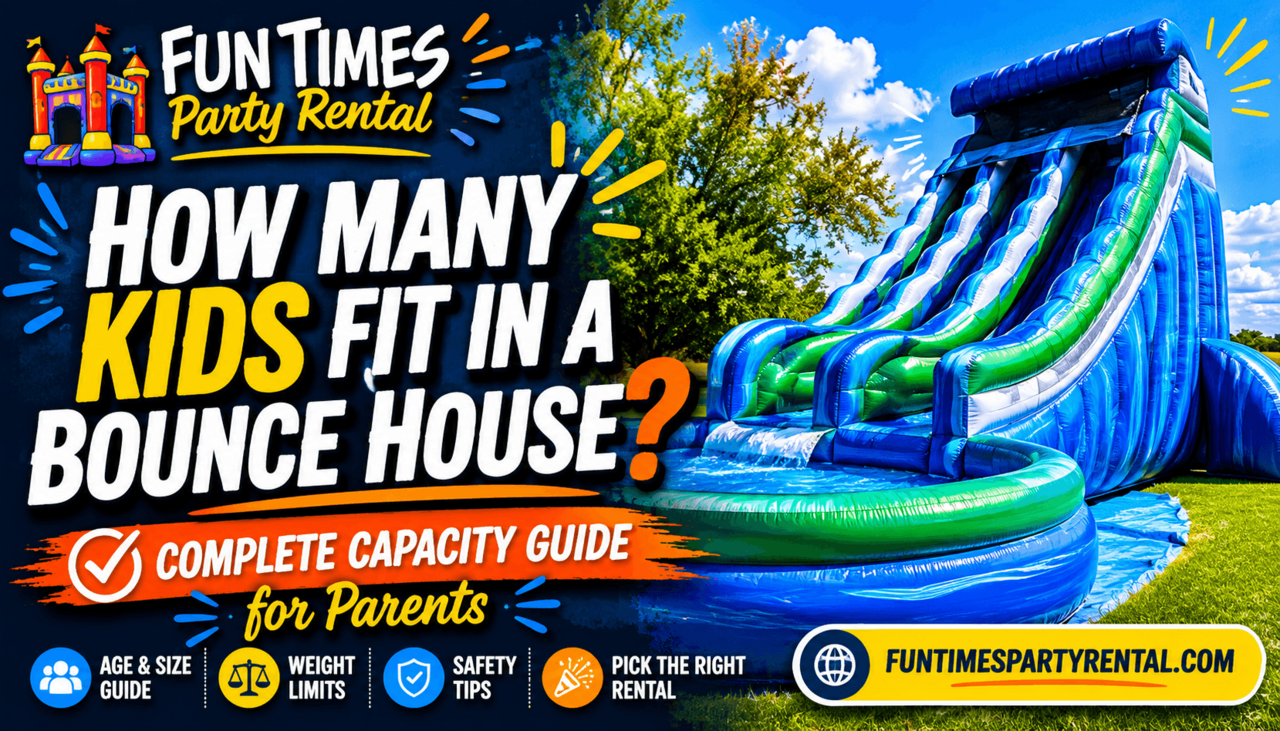
For safe at-one-time limits, read our related guide: How Many People Can Fit in a Bounce House?
Throughput is the number of children who can enjoy the inflatable over the course of the party. Because kids naturally rotate in and out, the total number entertained can be much higher than the safe inside-at-one-time number.
This is the more useful number when planning birthday parties, school events, church events, festivals, and neighborhood gatherings.
For a backyard birthday party, one inflatable may work perfectly. For a school event or church festival with a steady line of kids, one bounce house may not move children through fast enough. That is where throughput matters.
Estimated Throughput
The exact number depends on age, supervision, party flow, and how long each child stays inside. These estimates are planning ranges, not safety limits.
| Rental Type | Estimated Kids Per Hour | Best For | Planning Notes |
|---|---|---|---|
| Standard Bounce House | 15–30 kids per hour | Small backyard birthdays | Works best when kids are similar in age and adults rotate groups when needed. |
| Combo Bouncer | 20–40 kids per hour | Birthday parties and mixed-age groups | The slide adds more activity, which can keep kids moving better than jumping alone. |
| Water Slide | 25–45 kids per hour | Summer birthdays and hot-weather parties | Kids usually move through slides faster than open bounce areas, especially with good supervision. |
| Obstacle Course | 35–70 kids per hour | School events, church events, festivals, and large groups | Obstacle courses are built for movement and can handle lines better than a basic bounce house. |
A bounce house should never be overcrowded just because more children are waiting. Throughput improves when kids rotate safely, not when too many children are allowed inside at the same time.
Real-World Planning
Use these examples to think through your guest count, event length, and whether kids will all be trying to play at the same time.
One bounce house or combo bouncer is usually enough for a typical birthday party, especially if the event is 2 to 4 hours and kids are not all the same age.
One larger combo may still work, but you should think about wait times. If kids are close in age and very active, a second attraction can make the party flow better.
For larger events, one basic bounce house is usually not enough. Obstacle courses, water slides, combo bouncers, and multiple attractions help reduce lines.
A bounce house at a 4-hour party can entertain more children than the same bounce house at a 90-minute event. If your event is short and the guest count is high, you may need a faster-moving attraction or more than one rental.
Choose the Right Rental
The best rental depends on the event. A small birthday party does not need the same setup as a school field day, church event, or neighborhood festival.
For smaller backyard birthdays, a standard bounce house or combo bouncer usually works well. Kids can jump, take breaks, eat cake, open gifts, and come back to play throughout the party.
For larger groups, obstacle courses and water slides usually move kids through faster. These rentals work well when you expect lines, rotations, or a steady flow of children.
If you are not sure whether you need a bounce house, combo bouncer, water slide, or obstacle course, read our guide: What’s the Difference Between Inflatables Anyways?
What Affects Throughput?
Two parties can have the same bounce house and the same number of kids, but the experience may feel completely different depending on how the party is organized.
Younger kids usually need slower rotations and more supervision. Older kids may move faster, but they also need more space and should not be mixed with toddlers.
A supervised inflatable moves better because adults can manage turns, prevent overcrowding, and keep children from staying inside too long when others are waiting.
Cake, food, gifts, announcements, and games all affect how often kids use the inflatable. At some parties, kids rotate naturally without needing strict turns.
Obstacle courses and water slides tend to move children through faster than open bounce areas because the activity has a clear path from start to finish.
A longer party gives kids more chances to rotate through. A short event with a large group may need more than one activity to avoid long waiting times.
When toddlers, younger kids, and older children attend the same party, rotations may need to be separated. That can reduce throughput but improve safety.
Planning Tip
One rental may be enough for many birthday parties. Larger events, mixed-age groups, and shorter event windows may need a second attraction.
For mixed-age events, two separate rentals can sometimes be safer and more enjoyable than one large inflatable. One unit can serve younger kids while another gives older kids a more active option.
Event Type Matters
The right number of inflatables depends on how many kids will attend, how long the event lasts, and whether children arrive all at once or throughout the day.
| Event Type | Common Setup | Throughput Advice |
|---|---|---|
| Backyard Birthday Party | One bounce house or combo bouncer | Usually enough for smaller groups when kids can rotate naturally over a few hours. |
| Summer Birthday Party | Water slide or wet combo | Water slides often move kids through well and keep the party more comfortable in hot weather. |
| School Event | Obstacle course plus additional inflatables | Plan for lines and rotations. A single bounce house may not be enough for large student groups. |
| Church or Community Event | Multiple attractions by age group | Separate younger children from older kids and offer multiple activities when attendance is high. |
| Festival or City Event | High-throughput attractions | Obstacle courses, slides, games, and multiple units usually work better than one open bounce area. |
Obstacle courses are often one of the best choices for large groups because they are built for movement. For more detail, read: Why Obstacle Course Rentals Are Event Game Changers.
Water Slide Planning
Water slides can move kids through quickly because each turn has a clear start and finish. That makes them a strong choice for summer birthdays, neighborhood parties, and hot-weather events.
Kids climb, slide, exit, and get back in line. That natural flow can reduce crowding compared with an open bounce house where children may stay inside longer.
Younger children, lower water pressure, limited supervision, or kids stopping at the bottom of the slide can slow the line. Adults should help keep the landing area clear.
The right slide depends on age, thrill level, backyard space, and guest count. Read: How to Choose the Right Water Slide for Your Next Event or Birthday Party.
Tell us your event date, city, guest count, age range, setup surface, and how long the party will last. We can help you decide whether one bounce house is enough or whether a combo bouncer, water slide, obstacle course, or second rental would make the event flow better.
FAQ
For many birthday parties, one bounce house or combo bouncer can work for around 30 kids if the party is long enough and adults help rotate children safely. If the event is short or all the kids are close in age and very active, a second attraction may create a better experience.
A standard bounce house may entertain roughly 15 to 30 kids per hour, depending on age, supervision, and how long kids stay inside. Combo bouncers, water slides, and obstacle courses may move children through faster.
No. Capacity is the number of children who can safely be inside at one time. Throughput is the total number of children who can enjoy the inflatable over the course of the party. For capacity limits, read How Many People Can Fit in a Bounce House?.
Often, yes. Obstacle courses are built for movement, racing, climbing, crawling, and exiting. That makes them a strong choice for school events, church events, festivals, and other events where many kids need turns.
It is better to separate toddlers and older kids whenever possible. Mixed ages can reduce throughput because adults may need to slow the rotation, separate groups, and manage safety more carefully.
Do not overcrowd the inflatable. Rotate children in smaller groups, separate younger and older kids, and shorten turns if needed. For future larger events, consider renting a second inflatable or choosing a higher-throughput attraction like an obstacle course.
Related Guides
These related guides can help you compare capacity, pricing, rental types, and birthday party planning options before you book.
Learn safe at-one-time capacity by age, size, and rental type.
Read Capacity Guide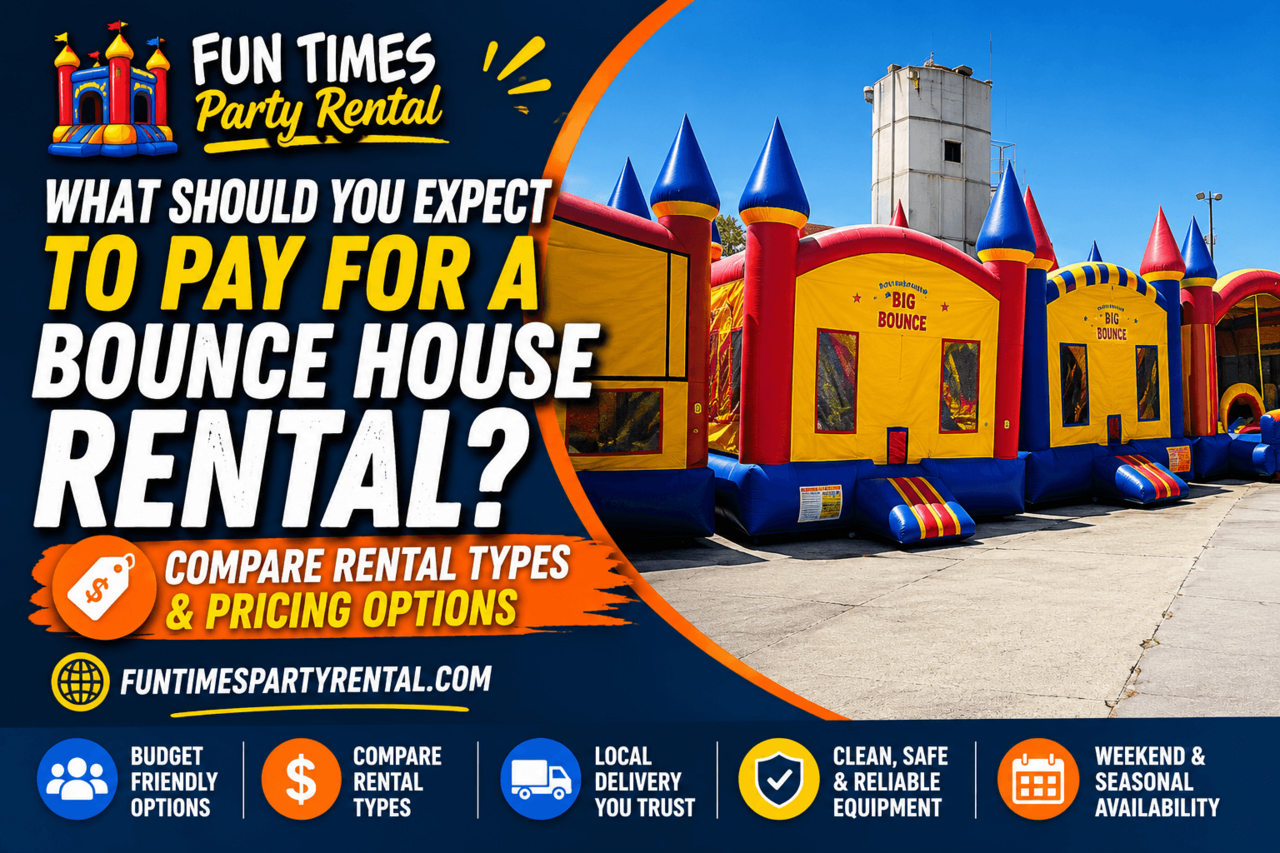
Compare bounce house rental pricing, event factors, and planning costs.
Read Pricing Guide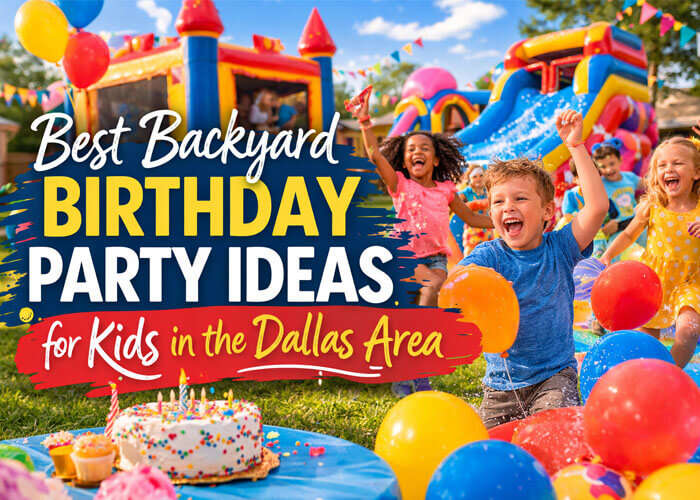
Get more ideas for planning a fun backyard birthday or family celebration.
Read Party IdeasFun Times Party Rental www.funtimespartyrental.com 214-277-4953